Monday, May 9, 2011

Kenneth Snelson


My art is concerned with nature in its primary aspect, the patterns of physical forces in three dimensional spaces.”

He is an artist first and foremost, not a scientist. Still the sculptures and designs of his vocation have brought some light into the science world.  

Snelson work takes on a simple design of line, space and dimension with experiencing with raw material such as wire, tubes and cables. His sculptures maintain their structural integrity beyond gravity, in the void of space. Mixing art with science, most of the designs expand the idea of objects in and or around there environment. He even has begun a new style of art called “Tensegrity," a structural balance of webs of steel cables and polished metal cylinders of various modest diameters. Both tension and integrity corporate the construct of the designs much similar to a spider web or a bike tire would hold to configuration. Sneleson tried to explain this idea saying “Temerity describes a closed structural system composed of a set of three or more elongate compression struts within a network of tension tendons, the combined parts mutually supportive in such a way that the struts do not touch one another, but press outwardly against nodal points in the tension network to form a firm, triangulated, prestressed, tension and compression unit.”

   Sneleson work is not just 3d objects but also in Atom Animations that he composed from 2007-2009. He has created some outstanding designs in computer graphics and print. He has written this concept of mathematical art in dozens of magazine articles.  

http://www.kennethsnelson.net/
http://www.kennethsnelson.net/icons/scul.htm

The Rainbow Arch, 2001  made of aluminum & stainless steel. Simple design made to with nothing more than steel and wires connected to form a rainbow shape arch. Ovoid of color this closed form remains enthralling for the uses of lines and shape. The skeleton of the arch is stringed together with slanted vertical lines moving from corner to corner in a gradual pattern. The movement of the pattern moves the eye back and forth in a rhythmic manner. The inner and outer space also gives the plan a sense of volume.  The second example of his work is the Sleeping Dragon. This sculpture also uses the same material of steel wire in metrical lines. The Sleeping Dragon, however doesn’t take on a simply shape that one would see in nature but more of animated style of movement common to Chinese dragons or snake. Reaming a closed form the lines move along its plane side to side in unison. The lat piece is the Needle Tower which is part of the collection Hirshhorn Museum & Sculpture Garden, Washington, D.C.  Looking up to it forms a star shape very similar to the Star of David. When asked if that was his intention he replied “although the double triangle is there to be sure. The six pointed star often seen in my sculptures is not intended as a symbol of any kind; nor are the many crosses. Six pointedness in this case comes out of the natural geometry of three elements (compression struts) at each layer or module. The sets of three alternate with right with left helical modules, adding up to six when seen looking up through the tower for example. It’s for that reason you see a six pointed star. A five pointed star would be a challenge since dividing five by two gives only two and a half. Two and a half compression members doesn’t compute.”

Rainbow Arch, 2001

Sleeping Dragon


Needle Tower


Sunday, May 8, 2011

Makoto Tojiki

 
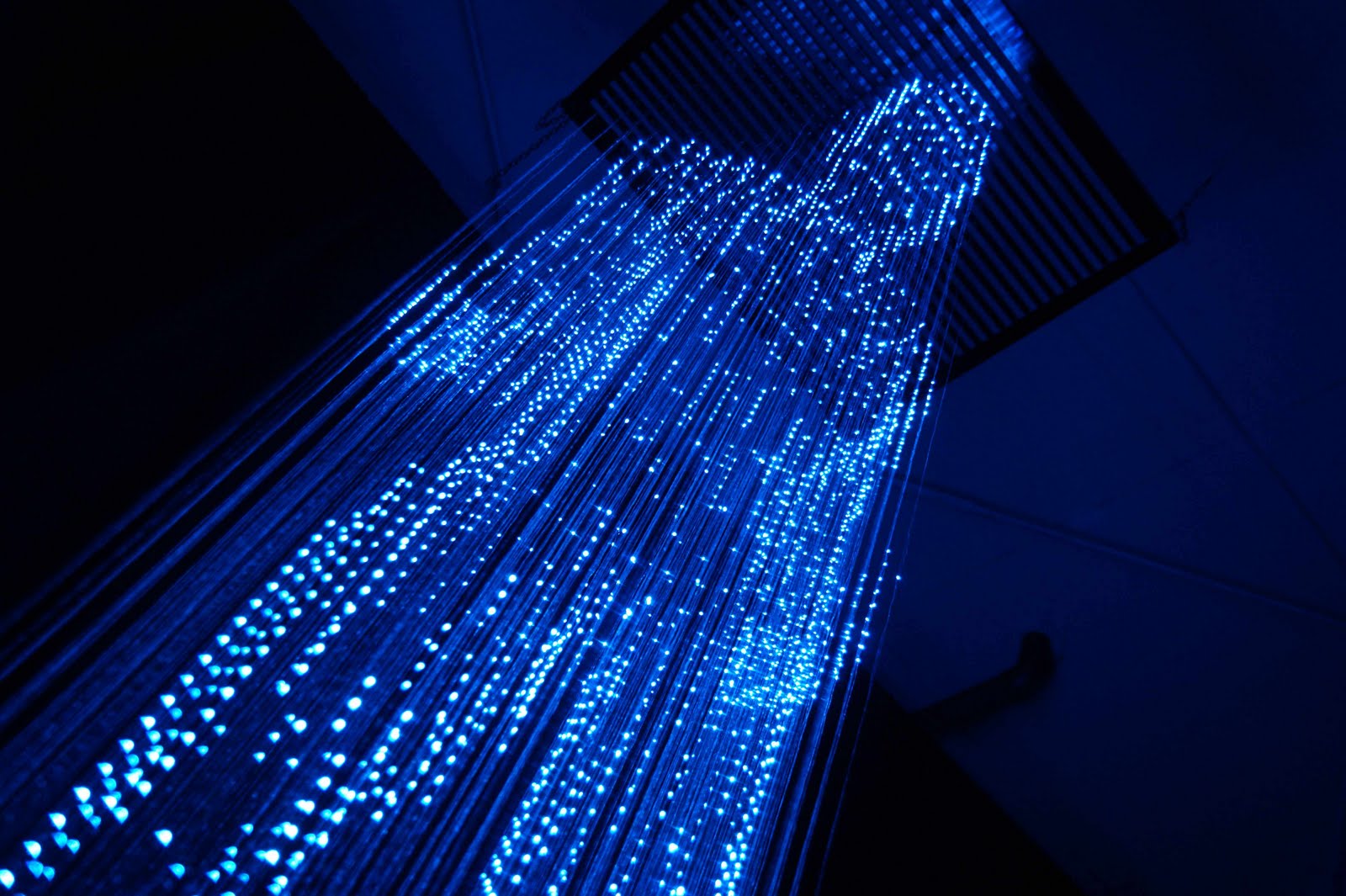
    Lights, color, action! That is the major ingredients presented in Tojiki artwork. Makoto Tojiki, a graduate of industrial design engineering in 1998 from Kinki University, is an artist and designer who use lights and familiar shapes as his primary medium of expression. Tojiki wanted to explore the use of light as it applied to function and intended use. Tojiki quoted “I hope the message I convey in a product changes the way people look at things, and I continue to make loving products that will bring a smile to people's faces when they find my message.”
    His most recent series “No Shadow" series is stimulated by the shadow and of light and can be shaped into a compound shape. The materials used on display are LED threads.

Website:
http://www.makototojiki.com

    Works included: "Man with No Shadow" It consists of LED lights at the ends of wires of different lengths suspended from the ceiling. This piece was displayed debut in Milan at the international design festival Salon Satellite.  The artist makes good with the use of the armature of line to give shape and volume to the object.  The subject is a statue of a man in a front potion which very selective to realism in terms of tone, gravity, weight, and symmetry.  It’s very interesting as the view can’t get a clear present ion of the shape from up close but must walk to a distance to see the overall design. The row of dots forms a single montage of shape which is placed in portion to the depth of the figure (close together or far apart). 


·         Tojiki doesn’t just apply this material to the human body but also to other animated forms for example; "Horse with No Shadow" and "The Blue Bird “both displayed in 2009.


In 2008 Tojiki took space, form, color, and balance to a piece he entitled’ Photon”or " See the Floating.”


Jen Stark

  Along with Callene's use of paper, Jen Stark, a Miami Florida resendent, also has expanded the boundaries of shape with the use of construction paper. She graduated with a BFA from Maryland Institute College of Art in 2005. but paper is not the only form of material she uses, she has other designs and media ranging from paintings, drawings, and animation. Most of her paper structures have been seen around the country and  are now part of the permanent collections of MOCA North Miami and The West Collection.  Stark has received many awards in the past; for example, in 2008 Stark won the "Winner of the MOCA North Miami Optic Nerve" in the  10th annual film festival and the "Recipient of the South Florida Cultural Consortium's Visual and Media Artists Fellowship" the same year.


Examples of her work include: "Centrifugal" commissioned in 2010 made from  hand-cut paper on wood backing and the measurement are 40'' x 31'' x 5''


The sculptures she has presented goes in different directions in the use of the plane transparency and repetition of lines. The positive and negective space  also plays a key role in the color usage and shape of the design. There is absence of relism as most the colors and flow of lines give to more other worldly feel of abstraction. The similarity with a rainbow are the layers the is complied with different shades of colors a more closed form of shape. Each piece of art here is repetitive to horizontal and vertical lines matching up either circular or rectangular shape in patterns. Lines in other pieces are more curry and moves along to animate an object. Some of Starks work is  closed forms wormholes, and sliced anatomy, while some other are arranged in a open form to expand and gives a sense of chaos and disparage. 

Other examples includes:1. 'Twirling Spectrum', (2010 hand-cut cardstock paper 12'' x 12'') 2. the "Tunnel Vision", 2009 (acrylic paint, wood, motor, mirrors, light 20'' x 25'' x 25'') the "
3. "Tri Angular" ( 2010, size 35" x 35" x 25" materials used with acrylic paint on wood backing)

1. Twirling Spectrum
2. the Tunnel Vision
3. Tri Angular


Other art worked is her paintings which are "High On Constellation" ( 26" x 40" / felt-tip pen on paper / 2009)


"Cosmic Dust" ( 22.5" x 30" / felt-tip pen on paper / 2008)